#include <threadpool.hh>
Classes | |
| struct | Job |
| class | PrivateData |
| class | Queue |
| class | WeakQueue |
Public Types | |
| using | Ptr = std::shared_ptr< ThreadPool > |
| using | ThreadPtr = std::shared_ptr< boost::thread > |
Public Member Functions | |
| ThreadPool (bool completeAllJobsBeforeDestruction=false) | |
| ThreadPool. | |
| ThreadPool (int count, bool completeAllJobsBeforeDestruction=false) | |
| ThreadPool (const ThreadPool &)=delete | |
| ThreadPool (ThreadPool &&)=delete | |
| ThreadPool | operator= (const ThreadPool &)=delete |
| ThreadPool | operator= (ThreadPool &&)=delete |
| ~ThreadPool () | |
| void | schedule (boost::function< void()> const &fn, int priority=defaultPriority, const Queue::Ptr &queue=defaultQueue()) |
| void | schedule (boost::function< void()> const &fn, const Queue::Ptr &queue) |
| template<typename T > | |
| void | schedule (std::shared_ptr< T > fn, int priority=defaultPriority, const Queue::Ptr &queue=defaultQueue()) |
| template<typename T > | |
| void | schedule (std::shared_ptr< T > fn, const Queue::Ptr &queue) |
| void | schedule (boost::function< void()> const &fn, int priority, const WeakQueue::Ptr &queue) |
| void | schedule (boost::function< void()> const &fn, const WeakQueue::Ptr &queue) |
| template<typename T > | |
| void | schedule (std::shared_ptr< T > fn, int priority, const WeakQueue::Ptr &queue) |
| template<typename T > | |
| void | schedule (std::shared_ptr< T > fn, WeakQueue::Ptr queue) |
| template<typename R > | |
| boost::unique_future< R > | schedule (boost::function< R()> const &fn, int priority=defaultPriority, const Queue::Ptr &queue=defaultQueue()) |
| template<typename R > | |
| boost::unique_future< R > | schedule (boost::function< R()> const &fn, const Queue::Ptr &queue) |
| template<typename R , typename T > | |
| boost::unique_future< R > | schedule (const std::shared_ptr< T > &fn, int priority=defaultPriority, const Queue::Ptr &queue=defaultQueue()) |
| template<typename R , typename T > | |
| boost::unique_future< R > | schedule (std::shared_ptr< T > fn, const Queue::Ptr &queue) |
| template<typename R > | |
| boost::unique_future< R > | schedule (boost::function< R()> const &fn, int priority, const WeakQueue::Ptr &queue) |
| template<typename R > | |
| boost::unique_future< R > | schedule (boost::function< R()> const &fn, WeakQueue::Ptr queue) |
| template<typename R , typename T > | |
| boost::unique_future< R > | schedule (const std::shared_ptr< T > &fn, int priority, const WeakQueue::Ptr &queue) |
| template<typename R , typename T > | |
| boost::unique_future< R > | schedule (std::shared_ptr< T > fn, WeakQueue::Ptr queue) |
| ThreadPtr | add () |
| std::vector< ThreadPtr > | add (int count) |
Static Public Member Functions | |
| static ThreadPool::Ptr | create (bool completeAllJobsBeforeDestruction=false) |
| static ThreadPool::Ptr | create (int count, bool completeAllJobsBeforeDestruction=false) |
Static Private Member Functions | |
| static void | work (const PrivateData::Ptr &priv) |
| static void | do_one (const PrivateData::Ptr &priv) |
| static Queue::Ptr | defaultQueue () |
Private Attributes | |
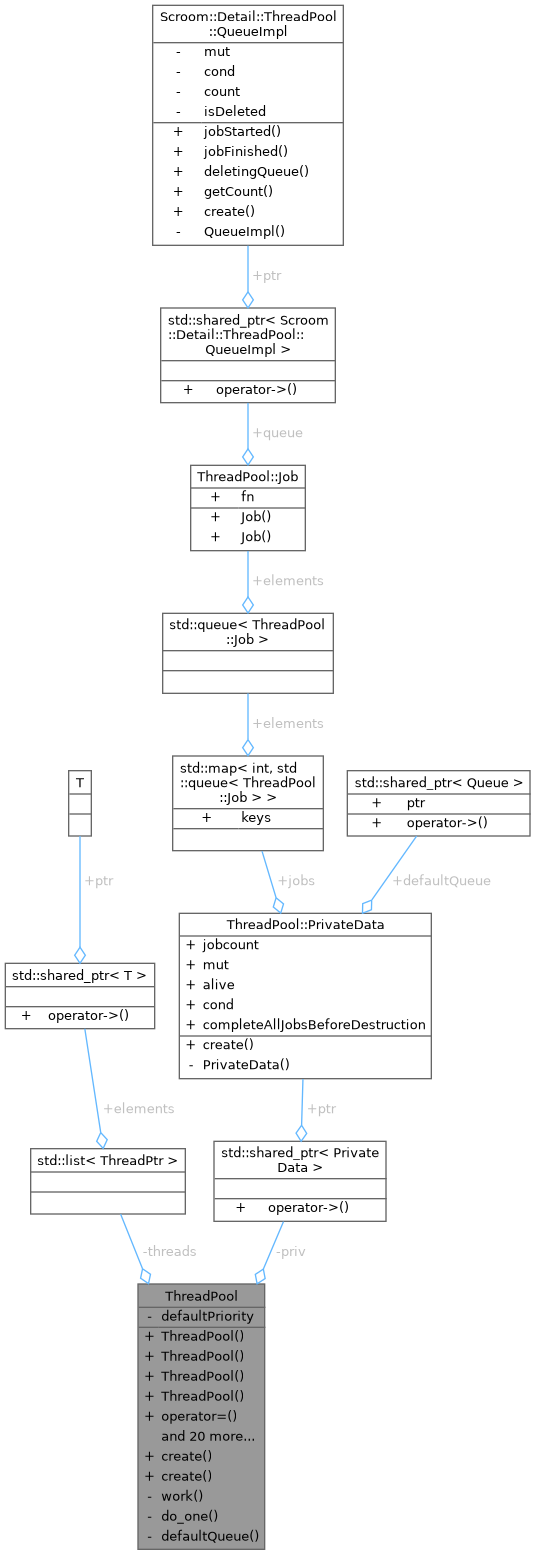
| std::list< ThreadPtr > | threads |
| PrivateData::Ptr | priv |
Static Private Attributes | |
| static const int | defaultPriority = PRIO_NORMAL |
Detailed Description
Generic threadpool
A ThreadPool is basically a collection of threads you can schedule() work on.
Member Typedef Documentation
◆ Ptr
| using ThreadPool::Ptr = std::shared_ptr<ThreadPool> |
◆ ThreadPtr
| using ThreadPool::ThreadPtr = std::shared_ptr<boost::thread> |
Constructor & Destructor Documentation
◆ ThreadPool() [1/4]
|
explicit |
Create a ThreadPool with one thread for each core in the system

◆ ThreadPool() [2/4]
|
explicit |
Create a ThreadPool with the given number of threads

◆ ThreadPool() [3/4]
|
delete |
◆ ThreadPool() [4/4]
|
delete |
◆ ~ThreadPool()
| ThreadPool::~ThreadPool | ( | ) |
Destructor
- stop all threads
- throw away all jobs that haven't been executed
Member Function Documentation
◆ add() [1/2]
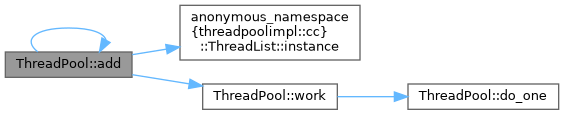
| ThreadPool::ThreadPtr ThreadPool::add | ( | ) |
Add an additional thread to the pool.
This is mostly used for testing
- Returns
- a reference to the newly added thread.
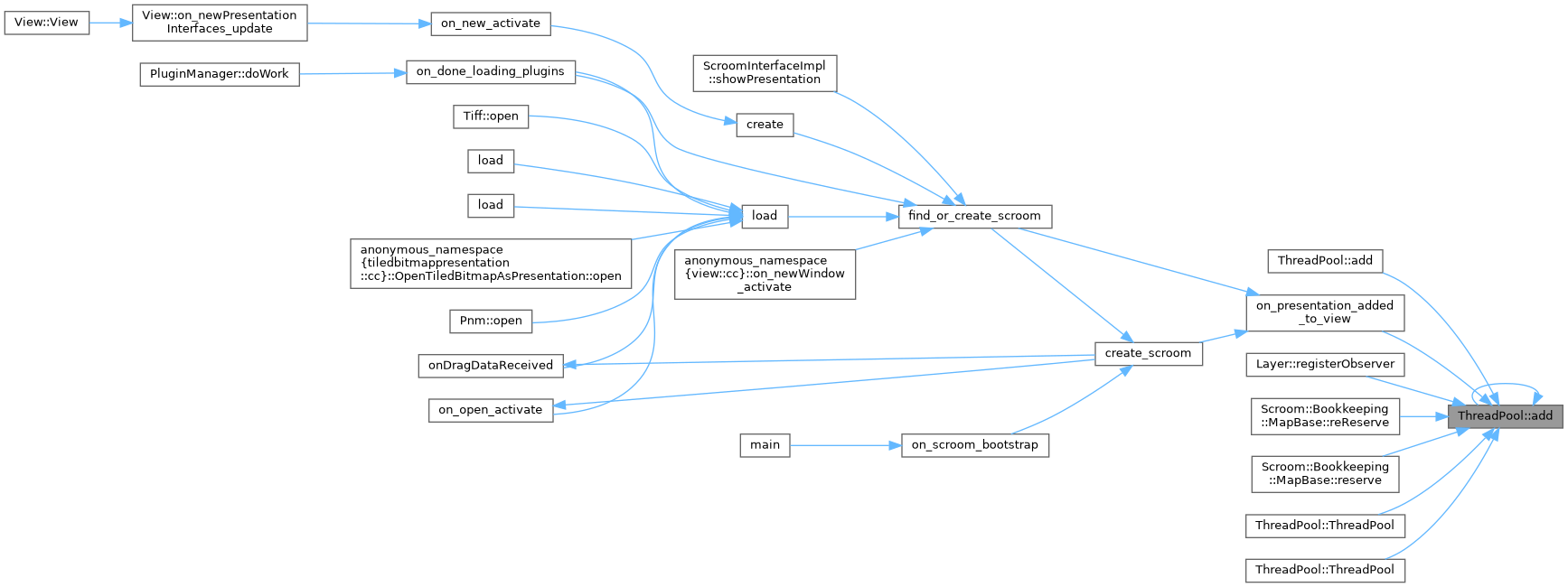
Referenced by add(), add(), on_presentation_added_to_view(), Layer::registerObserver(), Scroom::Bookkeeping::MapBase< K, V >::reReserve(), Scroom::Bookkeeping::MapBase< K, V >::reserve(), ThreadPool(), and ThreadPool().
◆ add() [2/2]
| std::vector< ThreadPool::ThreadPtr > ThreadPool::add | ( | int | count | ) |
Add the given number of threads to the pool.
This is mostly used for testing
- Returns
- references to the newly added threads.

◆ create() [1/2]
|
static |
Create a ThreadPool with one thread for each core in the system
◆ create() [2/2]
|
static |
Create a ThreadPool with the given number of threads
◆ defaultQueue()
|
staticprivate |

◆ do_one()
|
staticprivate |
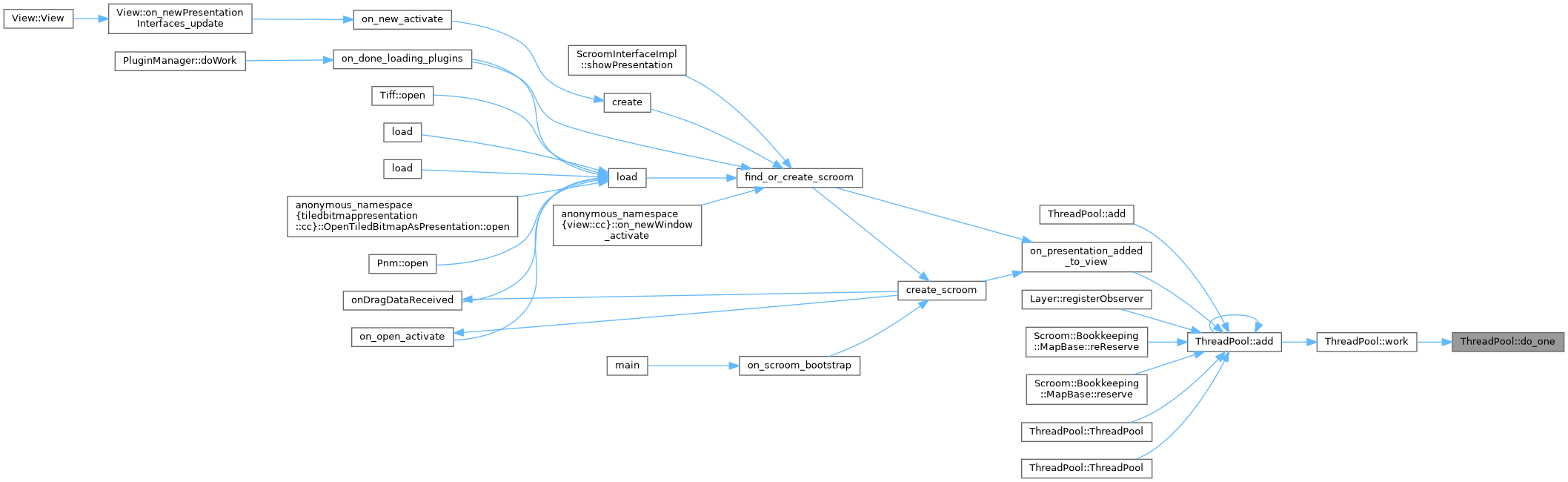
Execute one job.
This gets called from work(). It fetches and executes the highest-prio job from ThreadPool::jobs
Referenced by work().
◆ operator=() [1/2]
|
delete |
◆ operator=() [2/2]
|
delete |
◆ schedule() [1/16]
| boost::unique_future< R > ThreadPool::schedule | ( | boost::function< R()> const & | fn, |
| const Queue::Ptr & | queue | ||
| ) |

◆ schedule() [2/16]
| boost::unique_future< R > ThreadPool::schedule | ( | boost::function< R()> const & | fn, |
| int | priority, | ||
| const WeakQueue::Ptr & | queue | ||
| ) |

◆ schedule() [3/16]
| boost::unique_future< R > ThreadPool::schedule | ( | boost::function< R()> const & | fn, |
| int | priority = defaultPriority, |
||
| const Queue::Ptr & | queue = defaultQueue() |
||
| ) |

◆ schedule() [4/16]
| boost::unique_future< R > ThreadPool::schedule | ( | boost::function< R()> const & | fn, |
| WeakQueue::Ptr | queue | ||
| ) |

◆ schedule() [5/16]
| void ThreadPool::schedule | ( | boost::function< void()> const & | fn, |
| const Queue::Ptr & | queue | ||
| ) |
Schedule the given job at the given queue

◆ schedule() [6/16]
| void ThreadPool::schedule | ( | boost::function< void()> const & | fn, |
| const WeakQueue::Ptr & | queue | ||
| ) |
Schedule the given job at the given queue

◆ schedule() [7/16]
| void ThreadPool::schedule | ( | boost::function< void()> const & | fn, |
| int | priority, | ||
| const WeakQueue::Ptr & | queue | ||
| ) |
◆ schedule() [8/16]
| void ThreadPool::schedule | ( | boost::function< void()> const & | fn, |
| int | priority = defaultPriority, |
||
| const Queue::Ptr & | queue = defaultQueue() |
||
| ) |
Schedule the given job at the given priority
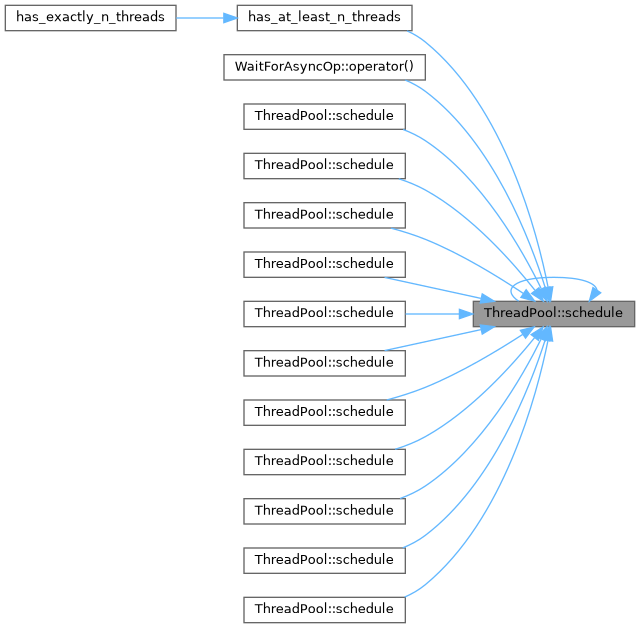
Referenced by has_at_least_n_threads(), WaitForAsyncOp::operator()(), schedule(), schedule(), schedule(), schedule(), schedule(), schedule(), schedule(), schedule(), schedule(), schedule(), schedule(), and schedule().
◆ schedule() [9/16]
| boost::unique_future< R > ThreadPool::schedule | ( | const std::shared_ptr< T > & | fn, |
| int | priority, | ||
| const WeakQueue::Ptr & | queue | ||
| ) |

◆ schedule() [10/16]
| boost::unique_future< R > ThreadPool::schedule | ( | const std::shared_ptr< T > & | fn, |
| int | priority = defaultPriority, |
||
| const Queue::Ptr & | queue = defaultQueue() |
||
| ) |
◆ schedule() [11/16]
| void ThreadPool::schedule | ( | std::shared_ptr< T > | fn, |
| const Queue::Ptr & | queue | ||
| ) |
Schedule the given job at the given priority
- Precondition
- T::operator()() must be defined

◆ schedule() [12/16]
| boost::unique_future< R > ThreadPool::schedule | ( | std::shared_ptr< T > | fn, |
| const Queue::Ptr & | queue | ||
| ) |
◆ schedule() [13/16]
| void ThreadPool::schedule | ( | std::shared_ptr< T > | fn, |
| int | priority, | ||
| const WeakQueue::Ptr & | queue | ||
| ) |
Schedule the given job at the given priority
- Precondition
- T::operator()() must be defined

◆ schedule() [14/16]
| void ThreadPool::schedule | ( | std::shared_ptr< T > | fn, |
| int | priority = defaultPriority, |
||
| const Queue::Ptr & | queue = defaultQueue() |
||
| ) |
Schedule the given job at the given priority
- Precondition
- T::operator()() must be defined

◆ schedule() [15/16]
| void ThreadPool::schedule | ( | std::shared_ptr< T > | fn, |
| WeakQueue::Ptr | queue | ||
| ) |
Schedule the given job at the given priority
- Precondition
- T::operator()() must be defined

◆ schedule() [16/16]
| boost::unique_future< R > ThreadPool::schedule | ( | std::shared_ptr< T > | fn, |
| WeakQueue::Ptr | queue | ||
| ) |

◆ work()
|
staticprivate |
This is executed by each of the threads in the ThreadPool
- Wait for a job to be scheduled
- Fetch the highest-prio job from ThreadPool::jobs
- Execute
Those last two tasks will be performed by do_one()
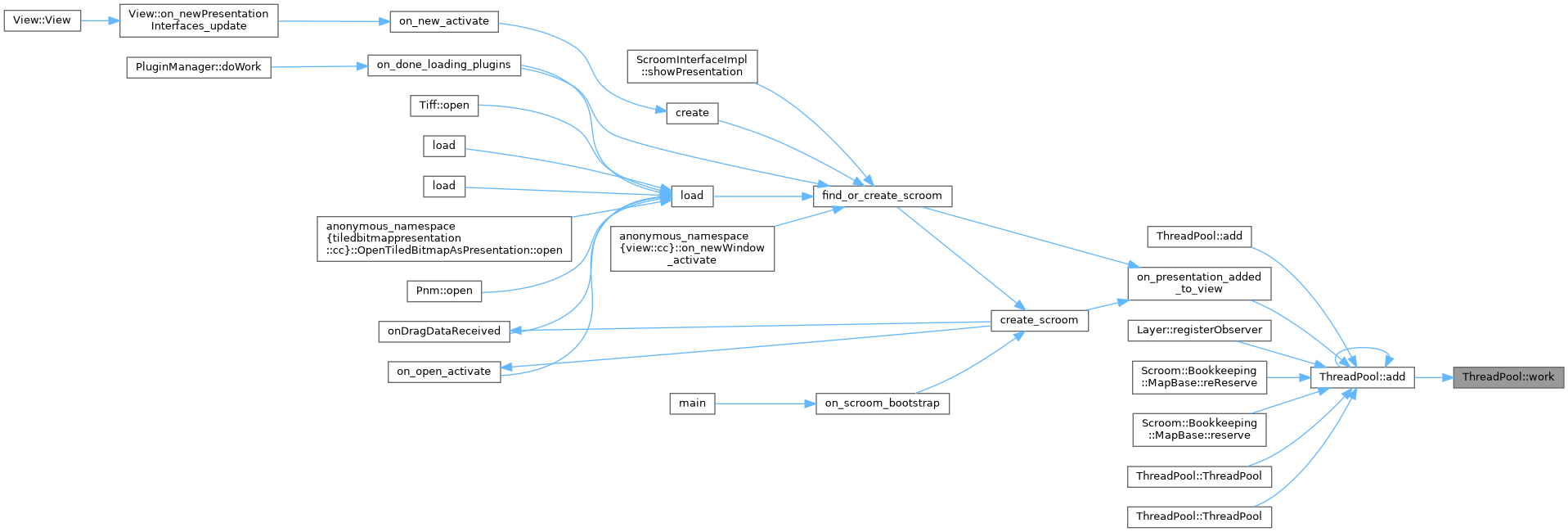
Referenced by add().

Member Data Documentation
◆ defaultPriority
|
staticprivate |
Referenced by schedule(), schedule(), schedule(), schedule(), schedule(), and schedule().
◆ priv
|
private |
Referenced by add(), do_one(), schedule(), work(), and ~ThreadPool().
◆ threads
|
private |
Threads in this ThreadPool
Referenced by add().
The documentation for this class was generated from the following files:
- libs/threadpool/inc/scroom/threadpool.hh
- libs/threadpool/inc/scroom/impl/threadpoolimpl.hh
- libs/threadpool/src/threadpoolimpl.cc