#include <threadpool.hh>

Public Types | |
| using | Ptr = std::shared_ptr< Queue > |
| using | WeakPtr = std::weak_ptr< Queue > |
Public Member Functions | |
| ~Queue () | |
| std::shared_ptr< Scroom::Detail::ThreadPool::QueueImpl > | get () |
| std::shared_ptr< WeakQueue > | getWeak () |
Static Public Member Functions | |
| static Ptr | create () |
| ThreadPool::Queue. | |
| static Ptr | createAsync () |
Private Member Functions | |
| Queue () | |
| Queue (const Queue &)=delete | |
| Queue (Queue &&)=delete | |
| Queue & | operator= (const Queue &)=delete |
| Queue & | operator= (Queue &&)=delete |
Private Attributes | |
| std::shared_ptr< WeakQueue > | weak |
Detailed Description
Represent a Queue in the ThreadPool.
If pass in a Queue object when you schedule() your job, then your job will be scheduled on that particular queue. This does not in any way affect the order in which jobs are executed. Use priority for that. Instead, if you later delete your Queue, any jobs scheduled on that Queue will not be executed any more.
When you delete the Queue, your thread will block until any jobs currently being executed have finished. I.e. after the Queue is destroyed, no jobs will be running any more, nor will any be run in the future. This can cause deadlocks if a job running on a ThreadPool tries to destroy its own queue.
To avoid deadlock, you should make sure that jobs running on the ThreadPool only have references to WeakQueue objects, or you should create your Queue using createAsync(). This will do the actual Queue destruction on a separate thread. As a result, after the last reference to the Queue object goes out of scope, jobs on the Queue may continue running for some time.
Member Typedef Documentation
◆ Ptr
| using ThreadPool::Queue::Ptr = std::shared_ptr<Queue> |
◆ WeakPtr
| using ThreadPool::Queue::WeakPtr = std::weak_ptr<Queue> |
Constructor & Destructor Documentation
◆ ~Queue()
| ThreadPool::Queue::~Queue | ( | ) |
◆ Queue() [1/3]
|
private |
◆ Queue() [2/3]
|
privatedelete |
◆ Queue() [3/3]
|
privatedelete |
Member Function Documentation
◆ create()
|
static |
When the last reference goes out of scope, synchronously destroy the Queue, blocking until any currently running jobs are finished.
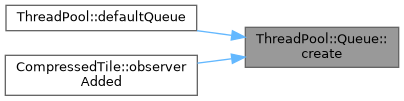
Referenced by ThreadPool::defaultQueue(), and CompressedTile::observerAdded().
◆ createAsync()
|
static |
When the last reference goes out of scope, asynchronously destroy the Queue. Jobs scheduled on the Queue may continue running for some time.
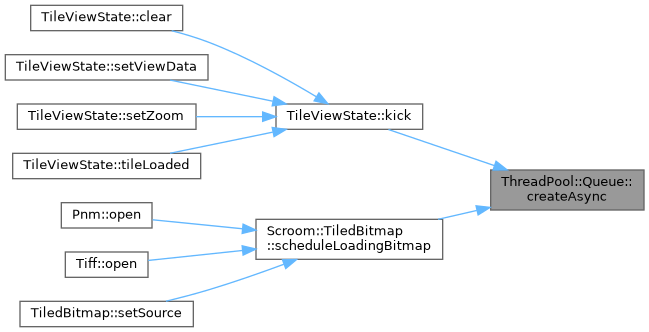
Referenced by TileViewState::kick(), and Scroom::TiledBitmap::scheduleLoadingBitmap().
◆ get()
| QueueImpl::Ptr ThreadPool::Queue::get | ( | ) |
◆ getWeak()
| ThreadPool::WeakQueue::Ptr ThreadPool::Queue::getWeak | ( | ) |
◆ operator=() [1/2]
◆ operator=() [2/2]
Member Data Documentation
◆ weak
|
private |
The documentation for this class was generated from the following files:
- libs/threadpool/inc/scroom/threadpool.hh
- libs/threadpool/src/threadpoolimpl.cc