Loading...
Searching...
No Matches
Public Types |
Public Member Functions |
Static Public Member Functions |
Private Member Functions |
Private Attributes |
List of all members
ThreadPool::WeakQueue Class Reference
#include <threadpool.hh>
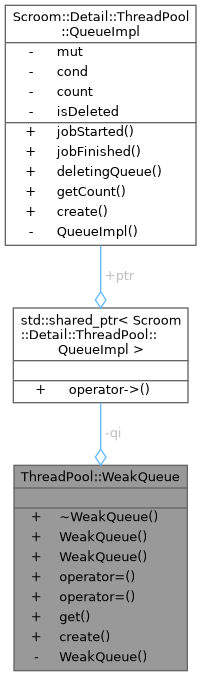
Collaboration diagram for ThreadPool::WeakQueue:
Public Types | |
| using | Ptr = std::shared_ptr< WeakQueue > |
| using | WeakPtr = std::weak_ptr< WeakQueue > |
Public Member Functions | |
| ~WeakQueue ()=default | |
| WeakQueue (const WeakQueue &)=delete | |
| WeakQueue (WeakQueue &&)=delete | |
| WeakQueue & | operator= (const WeakQueue &)=delete |
| WeakQueue & | operator= (WeakQueue &&)=delete |
| std::shared_ptr< Scroom::Detail::ThreadPool::QueueImpl > | get () |
Static Public Member Functions | |
| static Ptr | create () |
| ThreadPool::WeakQueue. | |
Private Member Functions | |
| WeakQueue () | |
Private Attributes | |
| std::shared_ptr< Scroom::Detail::ThreadPool::QueueImpl > | qi |
Detailed Description
Represent a weak Queue reference ThreadPool.
On occasion, you want tasks that are running on the ThreadPool to reschedule themselves. However, if tasks have a reference to their queue, you might risk a deadlock. If a tasks holds the last reference to the queue, then on task destruction, the queue will be destroyed. However, destroying the queue blocks for the task to finish.
As a way out of this, we introduce the WeakQueue, which can be used to schedule tasks, but does not contribute towards keeping the queue alive. I.e. If you destroy the last reference to a Queue, you can still use the associated WeakQueue to schedule tasks, but they will no longer be executed, because the Queue no longer exists.
- See also
- Queue
Member Typedef Documentation
◆ Ptr
| using ThreadPool::WeakQueue::Ptr = std::shared_ptr<WeakQueue> |
◆ WeakPtr
| using ThreadPool::WeakQueue::WeakPtr = std::weak_ptr<WeakQueue> |
Constructor & Destructor Documentation
◆ ~WeakQueue()
|
default |
◆ WeakQueue() [1/3]
|
delete |
◆ WeakQueue() [2/3]
|
delete |
◆ WeakQueue() [3/3]
|
private |
403{
404}
std::shared_ptr< Scroom::Detail::ThreadPool::QueueImpl > qi
Definition threadpool.hh:151
Member Function Documentation
◆ create()
|
static |
Definition threadpool.hh:131
◆ get()
| QueueImpl::Ptr ThreadPool::WeakQueue::get | ( | ) |
◆ operator=() [1/2]
◆ operator=() [2/2]
Member Data Documentation
◆ qi
|
private |
The documentation for this class was generated from the following files:
- libs/threadpool/inc/scroom/threadpool.hh
- libs/threadpool/src/threadpoolimpl.cc