Loading...
Searching...
No Matches
#include <scroom/threadpool.hh>#include <memory>#include <boost/date_time/posix_time/posix_time.hpp>#include <boost/thread.hpp>#include <boost/thread/future.hpp>#include <gtest/gtest.h>#include <scroom/function-additor.hh>#include <scroom/semaphore.hh>#include "helpers.hh"
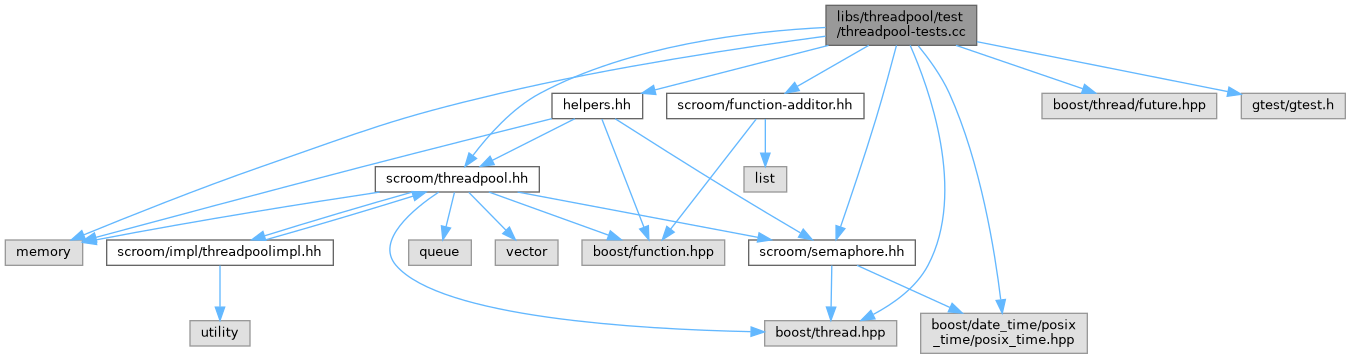
Include dependency graph for threadpool-tests.cc:
Classes | |
| class | A |
| class | B< R > |
Variables | |
| ThreadPool | pool (0) |
| Semaphore | low (0) |
| const int | expected = 2 |
| Semaphore | a (0) |
Function Documentation
◆ add()
| pool add | ( | ) |
◆ EXPECT_EQ() [1/2]
| EXPECT_EQ | ( | 42 | , |
| result. | get() | ||
| ) |
◆ EXPECT_EQ() [2/2]
| EXPECT_EQ | ( | false | , |
| result. | get() | ||
| ) |
◆ EXPECT_FALSE() [1/4]
| EXPECT_FALSE | ( | a. | Pshort_timeout | ) |
◆ EXPECT_FALSE() [2/4]
| EXPECT_FALSE | ( | high. | Pshort_timeout | ) |
◆ EXPECT_FALSE() [3/4]
| EXPECT_FALSE | ( | result. | is_ready() | ) |
◆ EXPECT_FALSE() [4/4]
| EXPECT_FALSE | ( | s. | Plong_timeout | ) |
◆ EXPECT_TRUE() [1/6]
| EXPECT_TRUE | ( | a. | Plong_timeout | ) |
◆ EXPECT_TRUE() [2/6]
| EXPECT_TRUE | ( | has_exactly_n_threads &, | 0pool | ) |
Initial value:
◆ EXPECT_TRUE() [3/6]
| EXPECT_TRUE | ( | has_exactly_n_threads(t.get(), 1) | ) |
◆ EXPECT_TRUE() [4/6]
| EXPECT_TRUE | ( | has_exactly_n_threads(t.get(), expected) | ) |
◆ EXPECT_TRUE() [5/6]
| EXPECT_TRUE | ( | high. | Plong_timeout | ) |
◆ EXPECT_TRUE() [6/6]
| EXPECT_TRUE | ( | s. | Plong_timeout | ) |
◆ has_at_least_n_threads()
| bool has_at_least_n_threads | ( | ThreadPool * | pool, |
| int | count_ | ||
| ) |
88{
89 if(count_ <= 0)
90 {
91 return true;
92 }
93
94 std::vector<Semaphore*> semaphores(count_);
95 for(int i = 0; i < count_; i++)
96 {
98 }
99
100 for(int i = 0; i < count_ - 1; i++)
101 {
103 }
104
105 // All tasks are blocked on semaphores[count-1]
106
108 // If jobs of the same priority are scheduled in order, and if
109 // there are at least count_ threads, then this final job will get
110 // scheduled on the last available thread, thus freeing all
111 // others.
113
115 {
116 // If there are too few threads, then all threads are still
117 // blocked. This will ultimately block the ThreadPool destructor,
118 // so we have to unblock them manually here.
119 for(int i = 1; i < count_; i++)
120 {
121 semaphores[i]->V();
122 }
123 }
125}
Definition semaphore.hh:16
void schedule(boost::function< void()> const &fn, int priority=defaultPriority, const Queue::Ptr &queue=defaultQueue())
Definition threadpoolimpl.cc:345
observers clear()
const millisec long_timeout(2000)
Referenced by has_exactly_n_threads().
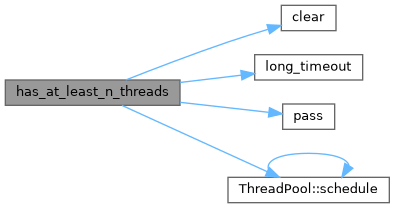
Here is the call graph for this function:
Here is the caller graph for this function:

◆ has_exactly_n_threads()
| bool has_exactly_n_threads | ( | ThreadPool * | pool, |
| int | count | ||
| ) |
128{
130}
bool has_at_least_n_threads(ThreadPool *pool, int count_)
Definition threadpool-tests.cc:87
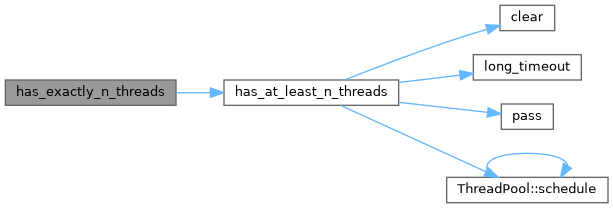
Here is the call graph for this function:
◆ long_timeout()
| const millisec long_timeout | ( | 2000 | ) |

◆ no_op()
template<typename R >
| R no_op | ( | Semaphore * | s, |
| R | result | ||
| ) |
◆ result() [1/2]
| boost::unique_future< bool > result | ( | pool.schedule< bool, B< bool > > | B< bool >::create(&a, false) | ) |
◆ result() [2/2]
| boost::unique_future< int > result | ( | pool.schedule< int > | [pa=&a] { return no_op(pa, 42);} | ) |
◆ schedule() [1/4]
◆ schedule() [2/4]
| pool schedule | ( | clear & | low, |
| PRIO_NORMAL | |||
| ) |
◆ schedule() [3/4]
◆ schedule() [4/4]
◆ short_timeout()
| const millisec short_timeout | ( | 250 | ) |
Variable Documentation
◆ a
| Semaphore a(0) | ( | 0 | ) |
Initial value:
{
ThreadPool pool(1)
◆ expected
| expected = 2 |
◆ low
◆ pool
| ThreadPool pool(0) | ( | 0 | ) |
Initial value:
Referenced by has_at_least_n_threads(), and has_exactly_n_threads().